One Take, No Rehearsal: Inside the Booth With the Voices That Read Advent Stories Aloud
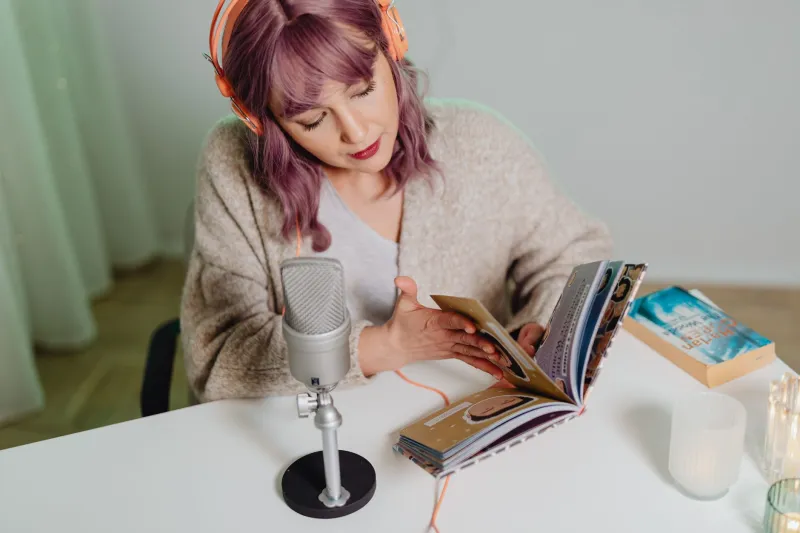
There's a particular kind of stage fright that only exists in December.
A stage actor gets weeks of rehearsal. A podcast host gets editing software and do-overs. But the narrators who read daily advent fiction — the ones whose voices pour out of smart speakers and earbuds between December 1st and the 24th — often get something closer to nothing. A fresh story, a deadline measured in hours, and one shot to make a stranger's words sound like they were always meant to be spoken.
We spent a week talking to the people behind those voices, and what we found was a small, obsessive, oddly festive corner of the audio world.
The Story Arrives at Midnight
Mara Ellison, a voice actor based in Chicago who has narrated an advent fiction podcast for four straight seasons, describes her December routine like a firefighter's.
"The story drops into my inbox the night before," she told us over Zoom, a blanket visibly wrapped around her shoulders despite the heated blanket already visible behind her. "I read it twice before bed — once for plot, once for feeling. Then in the morning I mark it up like a college student cramming: where I'll pause, where the tempo shifts, which line is the one the whole thing hangs on."
That last part matters more than most listeners realize. In a story you're hearing rather than reading, one sentence carries the emotional weight. Narrators call it the "turn," and finding it is the first job of the day.
"If I emphasize the wrong clause," Ellison says, "a sweet story about a father and daughter at a tree farm suddenly sounds like a horror story. I've done it. The listeners let me know."
Accent Is a Plot Decision
Here's something print readers never have to think about: the moment a narrator opens their mouth, they've made an editorial choice.
Should the grandmother from the story have a Southern drawl, or does that turn her into a stereotype? Does a light Boston inflection on the mailman add warmth or distraction? Voice directors in the advent-audio world talk about accents the way film directors talk about lighting — as atmosphere, not decoration.
Devon Park, an amateur reader in Portland, Oregon who records daily stories from a closet lined with moving blankets, learned this the hard way during his first season.
"I gave a character a full Minnesota accent because the story mentioned snow," he laughs. "By door twelve, the comments section had opinions. Now I keep accents to a whisper of suggestion. A hint of place, not a costume."
Park's setup cost him under $200 — a USB microphone, the closet, a wool coat hung over the door to deaden the echo. It's a reminder that this corner of the audio world runs on enthusiasm as much as expertise. Alongside union-rate professionals, hundreds of librarians, teachers, and retired radio folks read advent fiction for nothing but the joy of it, often for local community podcasts or library listening programs.
Pacing: The Invisible Instrument
Ask any of these narrators what separates a good daily read from a great one, and they all land on the same word: pacing.
But advent pacing has its own strange physics. A story meant to be consumed in ten minutes, on a commute, on a dark morning, needs a different rhythm than a bedtime read or a long-form audiobook. Too brisk and the listener misses the small domestic details that make seasonal fiction work — the burnt cookies, the tangled lights, the awkward office party. Too slow and the story collapses under its own coziness.
"I think of it like walking someone home," says Ellison. "You match their stride. On December 3rd, people are busy and distracted, so I keep things moving. By door 22, when listeners are emotionally raw and ready, I slow way down. The same narrator, essentially, but a different gait."
That's an instinct professional narrators develop over hundreds of hours. Amateur readers develop it by listening back to their own takes — which, Park admits, is its own special torture.
"Nobody hates their own voice like a person hearing it for the hundredth time in December," he says. "But it's the only way to learn where you rush."
No Reviews, No Safety Net
The thing every narrator we spoke to mentioned, unprompted, was the solitude of it. A new story arrives with no fanbase, no context, no sense of how it will land. There's no second take once it's published — the daily calendar waits for no one.
"With a novel, you can read reviews first and know what you're walking into," Park says. "Here, I open the file and it's just me and eight hundred words by someone I've never met. Sometimes it's about grief. Sometimes it's about a haunted fruitcake. I don't know until I read it."
That uncertainty, they both insist, is also the gift. Narrating a story nobody has ever heard means being its first audience — genuinely reacting, genuinely surprised, genuinely a little moved, all on microphone.
"Listeners can hear real laughter," Ellison says. "They can hear when my voice cracks. You can't fake that, and honestly, why would you want to?"
Try This at Home
Both narrators had advice for anyone tempted to record a story for their own family this December — a tradition more households are picking up as grandparents record stories for grandkids across the country.
Read it aloud once before you record anything, they say. Mark your breaths. Pick the one line that matters and slow down when you reach it. And resist the urge to perform — the goal isn't a radio drama, it's a voice at the kitchen table.
"The best compliment I ever got," Park says, "was a listener who wrote in that her son asked if the story was being read by 'someone's mom.' That's the bar. Not polish. Warmth."
Twenty-four doors. Twenty-four stories. Twenty-four chances for a voice — professional or homemade — to make a stranger's words feel like they were written just for you.
Somewhere out there, a narrator is marking up tomorrow's story right now, coffee cooling, one take ahead.