Forty Doors, Four Decades: The Minnesota Family Whose Advent Stories Became an Heirloom
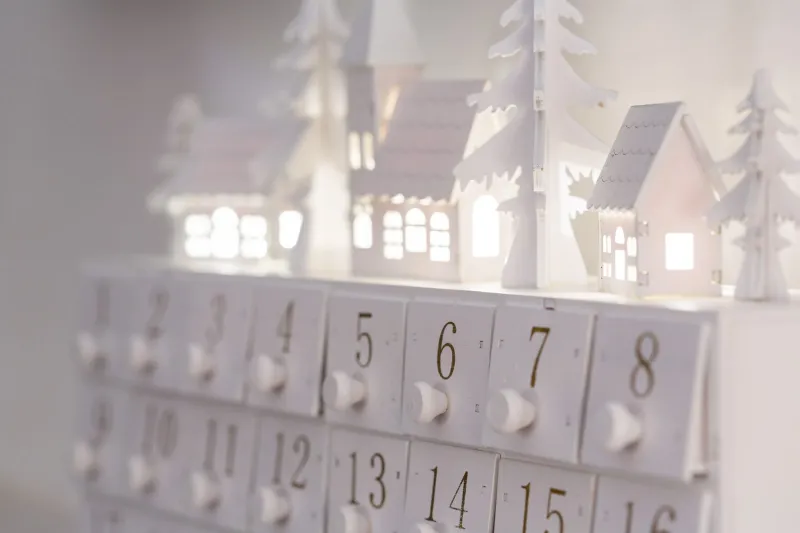
The Halvorsen family advent calendar doesn't look like much at first glance. It's a sheet of weathered poster board, slightly yellowed at the edges, with twenty-four small paper flaps glued on in uneven rows. The original glue has yellowed. Some of the flaps have been replaced — you can tell because the construction paper doesn't quite match. But the numbers, hand-drawn in red marker by a grandmother in 1985, are all still there.
Behind each one: a story.
It Started With a Bored November
Ruth Halvorsen, a retired schoolteacher from Duluth, Minnesota, invented the tradition almost by accident. Her three grandchildren, visiting that Thanksgiving, kept asking when Christmas was coming, and Ruth — out of patience and out of ideas — promised them a story for every day until Christmas Eve.
"I thought it would last one year," Ruth, now 87, told us from her kitchen table, where a laptop and a stack of legal pads sit side by side. "Then they came back the next December and asked where the doors were. What was I going to say? No?"
So she kept writing. Twenty-four stories a year, most of them a page long, about a recurring cast of characters she invented: a stubborn barn cat named Whiskers, a mail carrier who hated winter, two siblings named after her own grandchildren. The kids grew up. The characters didn't age much — "fiction's one great advantage," Ruth says — but the stories did.
When the Second Generation Took Over the Pen
Around 2003, Ruth's daughter Karen started contributing a few doors each December. By 2010, Ruth's grandson Peter — the same one who'd asked when Christmas was coming in 1985 — was writing his own stories for his kids, now the third generation of listeners.
The rules, such as they are, have stayed loose. Stories should be short enough to read aloud in under ten minutes. They should be appropriate for the youngest listener in the room, which currently means a six-year-old. And nobody, under any circumstances, peeks early.
"We had one incident in 2014," Peter admits. "My daughter opened door nineteen on December third. She was seven. She's nineteen now, and we still bring it up."
The collection itself now lives in a three-ring binder — actually, three binders — in Karen's house in St. Paul. Nearly 900 stories, sorted by year. The early ones are typed on a manual typewriter; the middle years are handwritten; the newest ones are printed from a laptop but still signed at the bottom, as tradition demands, by their author.
What Survives the Retelling
Spending an evening with the Halvorsens as they read this year's early doors, you notice something the family themselves have stopped seeing: the stories have become a kind of archive. Not of plots — many of the plots are, by Ruth's own cheerful admission, "thin as ice in April" — but of the family.
A story from 1991 mentions a dog the kids had long forgotten. A 2008 tale sneaks in a joke about Karen's disastrous attempt at fudge. Peter's stories from the pandemic years are noticeably quieter, and nobody in the family needs to say why.
"You read them back and you hear the year they were written in," Karen says. "It's like a diary that doesn't know it's a diary."
Researchers who study family storytelling have a term for this: narrative inheritance — the stories a family tells about itself, which shape how its members understand who they are. The Halvorsens have, perhaps without meaning to, built one of the more unusual versions of it in America: an inheritance measured not in objects or money, but in twenty-four installments a year.
The Question of Door 24
There is one tradition the family guards more carefully than any other: the story behind door 24 is always written by the oldest living author in the family, and it is always the same story, retold. It's the first story Ruth ever wrote — about the mail carrier who hated winter and the Christmas Eve he finally didn't.
"Every year someone offers to update it," Ruth says. "Every year I refuse. Some things you pass down exactly as they are."
This December, a fourth generation will hear it for the first time: Ruth's great-granddaughter, age three, who will sit in front of the same sagging poster board her grandmother sat in front of in 1985, and pull open the last flap.
Ruth hasn't decided who writes the stories after her. She says she's "working on it." But she has, quietly, already answered the bigger question. On the inside cover of the oldest binder, in her handwriting, is a single line she added a few years ago:
Keep the doors open.