Twenty-Four Tiny Canvases: The Artists Who Paint December One Door at a Time
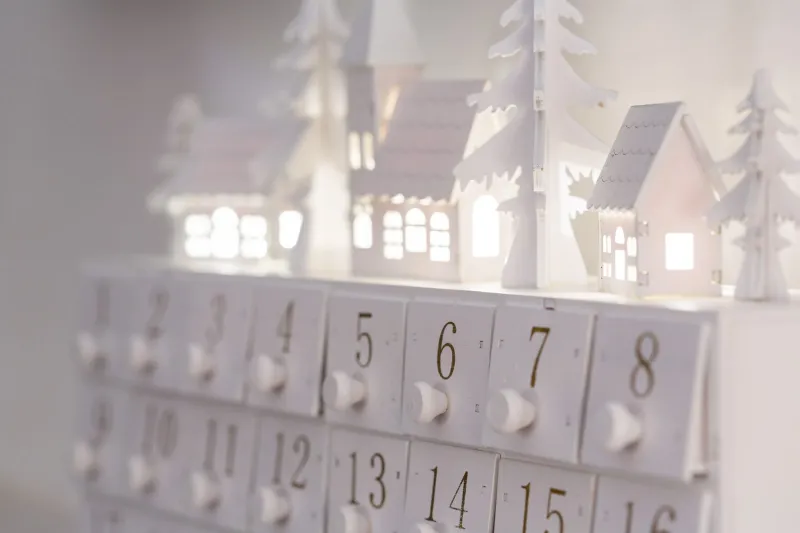
You know the moment. You flip open the front of a new advent calendar, and before your thumb finds Door Number One, you've already decided how the whole month is going to feel. Cozy? Playful? A little moody? That verdict happened in about two seconds, and it happened without a single word being read.
That's the quiet superpower of the illustrator.
While we spend a lot of time here celebrating the writers behind daily fiction — the ones sweating over what goes behind Door 24 — the people designing the doors themselves rarely get the spotlight. So this year, we wanted to pull back the curtain (or maybe the little paper flap) on the artists turning advent calendars into something closer to tiny galleries.
The Two-Second Promise
Ask any illustrator who works in this space and they'll tell you the same thing: cover art isn't decoration. It's a contract.
"The reader makes a promise to the calendar the moment they see it," says one Midwest-based designer who's spent a decade creating seasonal artwork for publishers and indie studios. "My job is to make a promise back. If the cover says 'warm cocoa and snow on the rooftops,' and Door 19 delivers a story about a parking lot argument, everybody loses."
That's why so much advent artwork leans into a shared visual vocabulary: glowing windows, fat flakes, string lights, the occasional red cardinal. These aren't clichés so much as shorthand — a way of telling your brain, settle in, you know this world.
But not every artist plays it safe, and that's where things get interesting.
Beyond the Snowy Village
The traditional advent aesthetic — think Bavarian village, church steeple, gold stars — still dominates American shelves. But a wave of younger illustrators is remixing it with everything from mid-century retro palettes to flat, punchy shapes that look more at home on a screen-printed poster than a greeting card.
Some artists are drawing on regional American winter imagery instead of imported European ones: brownstone stoops dusted white, desert sunsets in Tucson, a fishing town in Maine with lobster traps stacked like presents. Others lean abstract entirely — geometric doors, bold color blocking, typography that does the heavy lifting.
The result is a visual spectrum wider than the genre's ever had. And readers notice. Design-forward calendars have become collector's items, the kind people keep and reuse for years, or frame after the season ends. One Brooklyn illustrator told us her limited-run screen-printed calendar sells out every October — to buyers, she suspects, who never open a single door.
"I'm not even mad," she laughs. "Art that gets hung instead of opened is still art that got made."
Designing Anticipation
Here's the trickiest part of the job: advent artwork isn't really about the whole image. It's about the hidden part.
A great advent design has to work two ways at once. Closed, it's a complete composition — balanced, inviting, finished. Opened, door by door, it reveals surprises that were hiding in plain sight. A window that looked decorative turns out to hold a mouse in a tiny scarf. A snowbank conceals a sleigh. The best designs reward the peek without falling apart once the peeking's done.
It's a puzzle unique to the format, and it changes how artists work. Compositions get built in layers. Color choices are tested with doors both shut and open. Some designers sketch the "opened" version first and work backward, engineering the closed image around twenty-four little secrets.
Sound familiar? It should. It's exactly what our fiction writers do when they craft a story that reveals itself one day at a time. Illustrators and writers, it turns out, are solving the same problem with different tools: how do you make someone want to come back tomorrow?
Why the Unwrap Instinct Is Visual
Psychologists who study anticipation will tell you that much of the joy of a gift happens before it's opened — in the looking, the guessing, the not-yet. Advent calendars weaponize that instinct beautifully, and the artwork is the trigger.
A richly illustrated cover does something a plain grid of numbers can't: it gives your imagination a place to live while it waits. That snowy lane on the front isn't just pretty. It's the setting where all twenty-four stories will happen, whether or not the text ever mentions snow at all.
Which might explain why the format has thrived in the age of the scroll. A calendar asks you to look at one image, open one door, and stop. The art slows you down in the best way.
A Gallery You Get to Touch
There's a reason museums have started paying attention. Booked-up illustration fairs now feature seasonal design showcases, and art schools have begun treating advent calendar work as a legitimate — even prestigious — commission. Twenty-four miniature compositions plus a cover is a portfolio piece, not a gig.
So the next time you flip a calendar open and feel that little spark before Door Number One, take an extra second. Look at the rooftops, the color choices, the tiny details waiting to be discovered. Somewhere, an illustrator spent months engineering that exact feeling.
They built you a gallery. You get to walk through it one door at a time.