Twenty-Four Doors, Twenty-Four Melodies: Meet the Composer Who Scores December One Story at a Time
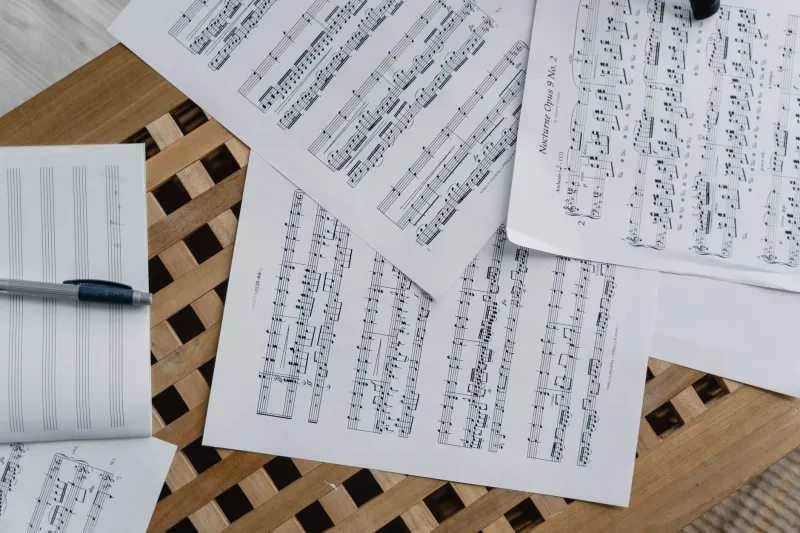
Elena Vasquez's studio in a converted barn outside Burlington, Vermont, doesn't look like a place where December gets made. There's a space heater, a slightly out-of-tune upright piano, and a wall of sticky notes — twenty-four of them, arranged in a grid like a very small quilt.
Each note carries a title. Door 7: the diner scene. Door 12: regret, but warm. Door 19: don't overdo the sleigh bells.
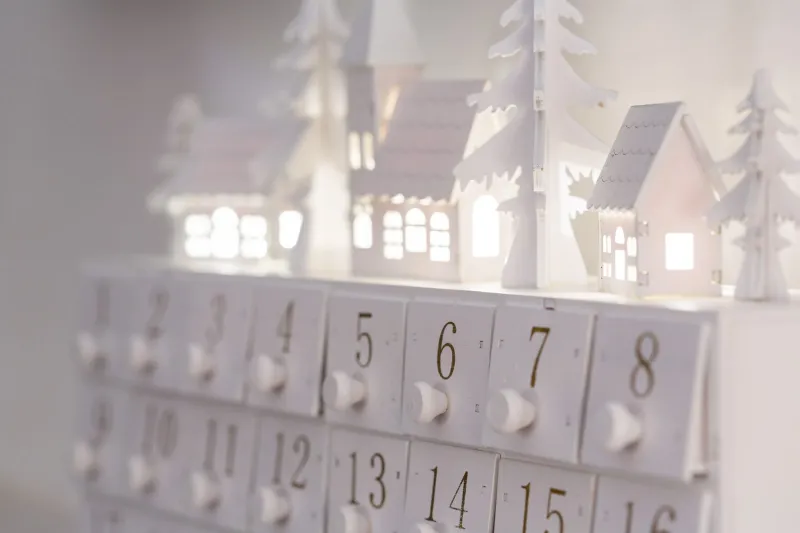
For the past three years, Vasquez has done something almost nobody else in American music attempts: she writes a miniature score for every single story in an advent calendar. Twenty-four pieces. Twenty-four moods. None longer than two and a half minutes.
"People assume it's just Christmas music," she says, laughing. "It's not. It's scoring a stranger's sentence about a woman returning a sweater. That's a different job entirely."
Scoring a Story You Can Read in the Time It Takes to Make Cocoa
The fundamental challenge, Vasquez explains, is scale. Film composers get ninety minutes to build a world. She gets roughly eight hundred words.
"In a feature film, you have time for themes, for development, for a leitmotif to come back transformed," she says. "In a two-minute story, the music has to arrive fully formed. It's less like a symphony and more like a haiku with an orchestra attached."
Her process starts with the manuscript itself. She reads the story before she touches an instrument, marking the emotional pivots — the moment a character hesitates, the line where the ending turns. Then she assigns each story what she calls a "temperature": not just major or minor, but something closer to weather.
"A bittersweet story about a father and son shoveling the driveway — that's twenty-eight degrees and sunny," she says. "Bright timbre, but with something cold underneath. Piano and celesta, maybe. No strings. Strings would make it too warm."
The constraints are brutal by design. Some pieces use only three instruments. One, for a story told entirely in a single voice, is a solo cello recorded in her stairwell for the natural reverb. Another — for a comic tale about a disastrous office potluck — is built entirely from kitchen percussion: a whisk on a bowl, a wine glass, the hum of a mini-fridge.
Why Music Makes a Small Story Feel Bigger
There's a reason the pairing works, and it isn't just holiday sentiment. Psychologists have long noted that music primes emotional interpretation — the same ambiguous sentence lands differently over a warm string swell than over a sparse, plucked note. For microfiction, where every word has to do heavy lifting, a score acts as a kind of emotional shorthand.
"The story handles the plot," Vasquez says. "The music tells you what it meant."
Readers of daily-fiction calendars have noticed. Comments on scored stories consistently mention the same thing: people slow down. A two-minute read becomes a three-minute experience, and that extra minute is where the mood settles in.
Build Your Own Story-and-Song Ritual
You don't need a composer in a Vermont barn to try this at home. Vasquez insists the ritual is the point, not the production value.
Her suggestions for a DIY version:
- Match the temperature, not the topic. Don't hunt for a song "about" the story. Ask what the story feels like — cozy, wistful, mischievous — and find a track with that weather.
- Keep it short. Two to three minutes. If the song outlasts the story, the story disappears.
- One pair per night. Like the calendar itself, the magic is in the rationing. Resist the playlist shuffle.
- Let silence do some work. For quiet stories, she sometimes scores them with near-silence — a single held note. Your kitchen at 7 a.m. can be the string section.
Her favorite pairing from this year, she says, is Door 24 — the one everyone saves for last.
"I won't spoil it," she says, tapping the last sticky note on the wall. "But I wrote it on the piano you're sitting next to, at two in the morning, after reading the story exactly once. Some doors you only get to open once."
Which, she notes, is the whole philosophy of the advent calendar — and apparently, of scoring one, too.