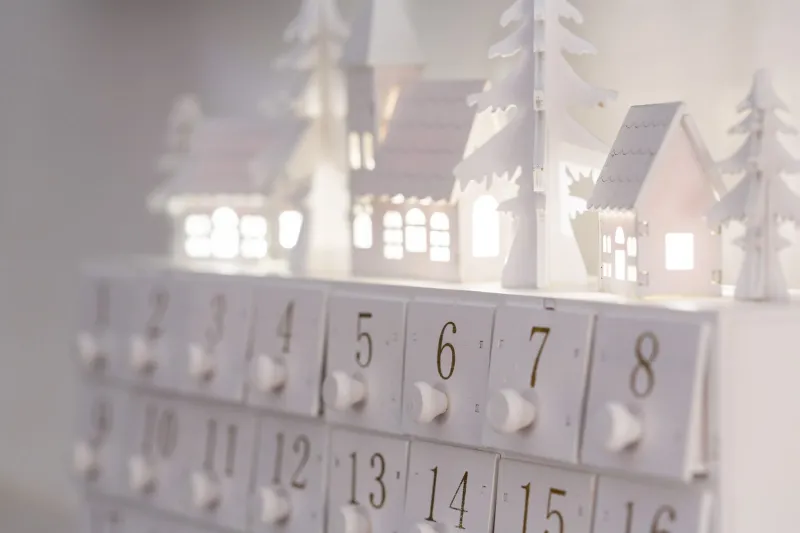
The Almost Stories: Inside the Drawer Where Rejected Christmas Fiction Goes to Wait

Somewhere in a shared Google Drive, between a folder of contracts and a spreadsheet of publication dates, there's a document titled, without much ceremony, "Holds."
It's where the almost-stories live. The ones we loved. The ones that nearly made the calendar. The ones that, for one reason or another, didn't get a door.
If you've been reading along with us this Advent — a story a night, like a piece of chocolate but for your imagination — you've probably never thought about the stories that didn't show up. That's kind of the point. A calendar feels inevitable once it's printed. Twenty-four (or twenty-five, if you're lucky) perfect little doors. But the truth is messier, sadder, and honestly a lot more interesting.
So we opened the drawer. Here's what fell out.
The One That Arrived at 12:01 A.M.
Every editor we talked to for this piece had a version of the same story: the submission that came in just past the deadline. Not a day late. Not even an hour late, in some cases. Minutes.
One writer we'll call Dana (she asked us to keep it vague — "my mother reads this site") submitted a gorgeous piece about a woman who runs a roadside diner outside Flagstaff and leaves the lights on all night for truckers who have nowhere else to spend Christmas Eve. It was warm without being saccharine, specific without being fussy. It was, frankly, one of the best things we read all year.
It arrived eleven minutes after submissions closed.
Here's the thing nobody tells you about editing a themed collection: the deadline isn't bureaucracy. It's load-bearing. Stories get slotted against each other, sequenced for pacing across the whole month, matched to the emotional arc of December itself. A story that lands on the 3rd needs to do different work than one that lands on the 21st. You can't just shuffle everything at the last second without the whole calendar wobbling.
Dana's story is in the drawer. It will almost certainly be on next year's calendar, assuming she'll still have us. Deadlines are cruel that way — and generous that way too.
Too Dark for December (But Only Barely)
Then there are the stories we rejected for tone, and honestly, this is where the heartbreak gets interesting.
America has a long, weird, wonderful relationship with dark holiday fiction — we've written before about the country's forgotten tradition of telling ghost stories at Christmas, a habit we imported from Victorian England and mostly abandoned, to our cultural loss. So you'd think we'd be the last people to reject a story for being too grim.
And yet. There's a difference between a story with shadows in it and a story where the shadow eats everything.
One submission — a genuinely well-crafted piece about a father grieving a lost child on a frozen lake in Minnesota — was rejected not because it was sad, but because of where it would have sat. It came in strong enough to claim a mid-December door, right in the thick of the run-up to Christmas, when readers are often reading tired, stressed, maybe a little raw themselves. Some nights, readers need the ache. Some nights they need the release. This story was an ache, and we already had our aches placed.
The writer, to their enormous credit, wrote back: "Fair. Which door do you need the ache on next year?"
That's the conversation most readers never see. Rejection, in seasonal fiction, is often really a scheduling question wearing a rejection's clothes.
The Problem of the Long Good Story
Here's a constraint that shapes everything and that we almost never talk about publicly: length.
A daily story has to actually fit in a day. Not a day of your life — a coffee break, a bus ride, ten quiet minutes after the kids are down. That's the whole deal we make with you. Small bites, big magic.
Which means every year we have to say goodbye to stories that are simply too good and too long. One editor described a 6,000-word piece about three generations of a Detroit family arguing over a hand-copied pierogi recipe as "the best thing I read all season, and I cut two-thirds of it and it still didn't work." Trimming a story isn't like trimming a hedge. Cut the wrong branch and the whole thing stops being alive.
Some of those long stories get published elsewhere. Some get rewritten tighter. And some just wait, patiently, in the drawer, being brilliant at the wrong length.
What the Drawer Teaches Us About the Doors
Spend enough time with the almost-stories and you start to notice something: the calendar isn't a ranking. The stories that made it aren't the "best" in some absolute sense. They're the best fit — the right length, the right tone, the right night.
Seasonal fiction is a craft of constraints. The deadline disciplines the writer. The word count disciplines the story. The calendar disciplines the editor. And the reader, opening one door a night, gets something that no anthology or endless feed can offer: a story that was chosen for this exact evening.
So if you've got a story in a drawer somewhere — a holiday piece that got passed over, or never submitted, or came in eleven minutes late — take this as your official nudge. The drawer is not where stories go to die. It's where they go to wait their turn.
Dana's diner lights are still on, by the way. We checked. Some stories keep.